The Advanced Diploma in Nautical Science (ADNS) in the Merchant Navy is an essential maritime education pathway for students and cadets who want to build a rewarding career as a deck officer . Unlike the standard one-year DNS route, ADNS is generally associated with advanced stages of nautical training and, depending on the program structure, may also be offered as a structured India-and-UK pathway.
There is a critical point to understand before choosing this course: ADNS is not the same as DNS. While the two names are sometimes grouped together because they form parts of the broader deck-officer career pipeline, they represent completely different stages or program designs.
Whether you are preparing completely on your own, taking coaching elsewhere, or just starting from scratch, having a reliable companion platform like Sailors Factory changes how you navigate this journey. Let’s break down everything you need to know about approvals, career pathways, and how to position yourself for success.
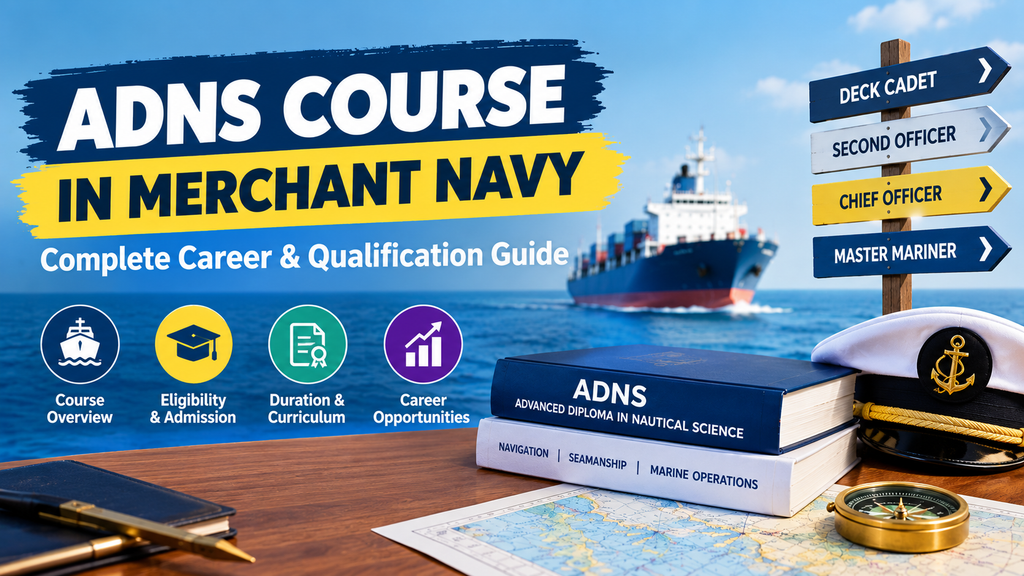
The Directorate General of Shipping (DGS) describes the nautical officer career as a progressive journey from deck cadet towards second officer, chief officer, and eventually master mariner.
ADNS stands for Advanced Diploma in Nautical Science.
It is designed around the professional development of students preparing for a specialized career on the deck side of merchant ships. Training focuses on advanced nautical knowledge, celestial navigation, seamanship, ship operations, safety management, and the core competencies required to progress smoothly toward officer-level responsibilities.
The exact curriculum and structure can differ significantly between institutions. Some programmes use ADNS as a qualification associated with the post-DNS/sea-training stage, while newer international programmes may offer ADNS as a complete dual-jurisdiction pathway involving study in India followed by specialized study in the United Kingdom.
This distinction matters when comparing ADNS courses. A student should never assume that every course advertised as “ADNS” shares the same duration, entry qualification, admission process, or certification pathway.
ADNS vs DNS: What Is the Difference?
DNS and ADNS are connected to the deck-officer career, but they are distinct qualifications:
| Feature | DNS (Diploma in Nautical Science) | ADNS (Advanced Diploma in Nautical Science) |
|---|---|---|
| Full Form | Diploma in Nautical Science | Advanced Diploma in Nautical Science |
| Duration & Structure | Usually a 1-year pre-sea programme | Structure varies heavily depending on the institution |
| Entry Point | Designed as a direct entry route after Class 12 PCM | Generally represents an advanced stage or alternative structured program |
| Training Phase | Followed by mandatory onboard sea training | May include advanced academic/nautical training and/or specialized sea-training components |
| Career Objective | Leads directly into the deck-cadet pathway | Builds towards higher-level nautical qualification and professional certification |
| Regulatory Framework | Offered by DGS/IMU-approved institutions | Recognition and structure must be verified for the specific program |
The standard Indian DNS route is currently described by the Indian Maritime University (IMU) as a one-year residential program, after which students proceed towards required sea training and competency examinations.
Before spending any money on applications, you can instantly check your standing using the free Eligibility Calculator & Salary Calculator to see which route fits your profile.
Some established nautical training programs have historically used ADNS to describe the qualification obtained after completing pre-sea and initial onboard milestones. Therefore, verifying the syllabus and certification body is non-negotiable.
ADNS Course Duration
There is no single duration that applies universally to every ADNS program in India, because the title is deployed for vastly different academic architectures.
For example, some international ADNS programs currently advertised in India follow a two-year study pathway, where the first year is conducted in an Indian institute and the second year takes place at a recognized UK maritime institution.
Other programs use ADNS as an advanced milestone after the candidate has completed DNS and initial onboard service. Before applying, students should meticulously check:
- Total course duration
- Geographical location for each academic year
- Exact qualification awarded upon completion
- DGS approval or recognition status
- UK MCA recognition (where applicable)
- Onboard sea-time requirements
- Company sponsorship and placement arrangements
- Certification pathway after completion
This due diligence is vital because the title “ADNS” alone does not reveal the complete professional trajectory.
ADNS Eligibility Criteria
Eligibility criteria depend entirely on the specific ADNS program structure.
For students coming directly after Class 12, an ADNS program may specify entry prerequisites similar to other nautical science pathways:
- Class 12 with Physics, Chemistry, and Mathematics (PCM)
- Required minimum percentage aggregate in PCM
- Passing grade in English language proficiency
- Prescribed age limits established by the institute or sponsoring lines
- Strict medical fitness compliance
- Eyesight and uncompromised colour-vision standards
However, programs where ADNS represents an advanced stage after DNS feature completely different entry requirements because applicants are already expected to have completed earlier maritime qualifications. Never assume uniform eligibility across different institutes.
For comparison, the standard Indian DNS route requires 10+2 with PCM, at least 60% aggregate in PCM, and 50% in English, as outlined in official IMU guidelines. You can test your readiness daily via the Daily Voyage Quiz.
ADNS Course After 12th
Students searching for ADNS programs directly after Class 12 must exercise extreme caution regarding program approvals and curriculum layout.
A conventional Indian deck officer pathway starts with a recognized pre-sea program like DNS, followed by 18 months of structured sea time and competency exams. Some institutions, however, market ADNS as an integrated alternative for school-leavers. These must be evaluated strictly based on statutory approvals and employment outcomes.
The ultimate objective of any nautical training program is to prepare candidates for elite service in the ship’s deck department.
A student entering this domain progresses through a structured hierarchy:
- Deck Cadet
- Third Officer
- Second Officer
- Chief Officer
- Master Mariner / Captain
Achieving these ranks requires clearing mandatory competency exams, accumulating certified sea service, and maintaining professional discipline.
ADNS Course and Sea Training
Practical shipboard experience forms the backbone of a successful deck officer’s career. While academic modules impart theoretical knowledge of navigation and stability, true professional competence is forged at sea.
Depending on the program, practical modules cover:
- Shipboard training and bridge watchkeeping
- Navigation-related watch duties
- Seamanship, rigging, and mooring operations
- Safety procedures and lifesaving appliance drills
- Cargo operations, stowage, and ballasting
- Ship maintenance and corrosion control
- Structured record keeping and cadet training assessments
Verify sea-placement guarantees before enrolling, or explore options through Merchant Navy Company Sponsorship.
ADNS Course and Certificate of Competency (CoC)
A diploma or academic certificate must never be confused with a Certificate of Competency (CoC).
The CoC is the legal statutory certification issued by maritime authorities that permits a seafarer to serve in a specific officer capacity onboard commercial vessels.
Students considering an ADNS program should direct these exact questions to admission counselors:
- What exact academic qualification will I receive?
- Which statutory authority recognizes this qualification?
- What CoC does this program lead towards?
- How much sea time is officially required and guaranteed?
- Where will the sea training take place?
- Which authority conducts the final competency examination?
Getting clear, written answers protects you from unverified programs.
ADNS India-UK Maritime Programmes
A notable variant of ADNS available in the market is the India-UK study pathway.
In these models, students complete their initial academic phase in India before transitioning to a recognized UK college (such as the City of Glasgow College) for advanced training under UK MCA frameworks. While this offers international exposure, students must verify that all Indian DGS or relevant flag-state certification requirements are fully satisfied.
Is ADNS Approved by DG Shipping?
Approval status depends entirely on the specific institute and program. The Directorate General of Shipping (DGS) maintains rigorous standards for maritime education in India. Its circulars explicitly mandate that non-DGS-approved courses must not be marketed as approved equivalents, and mandatory STCW modular courses require strict DGS compliance.
Before transferring any admission fees, verify:
- Active institute listing on the official DGS portal
- Specific course approval status
- Exact academic and professional qualifications awarded
- Compliance with STCW standards
- Guaranteed sea-training agreements
ADNS Course Fees in India
There is no uniform fee structure for ADNS courses.
India-only programs differ drastically in cost compared to India-UK dual-campus programs. International tracks factor in foreign tuition, visas, accommodation, insurance, and travel expenses. Always calculate the total cost of ownership rather than looking solely at first-year tuition. Furthermore, remember to test your visual fitness early using the free Colour Blindness Test for Merchant Navy.
ADNS Sponsorship
Sponsorship remains the cornerstone of secure Merchant Navy placements. While standard DNS paths have structured company sponsorship frameworks, ADNS sponsorship terms vary wildly across institutes.
Before accepting any sponsorship offer, clarify:
- Which exact shipping company is backing the program
- Whether shipboard training is contractually guaranteed
- Whether the company sponsors tuition or only provides placement
- Contingency protocols if academic or medical exams are failed
Never assume “sponsored” means entirely free education. For psychological and interview preparation, practice safely with the Practice Free Psychometric Test.
ADNS Medical Requirements
Medical fitness is a legal prerequisite for working at sea. Candidates must satisfy stringent standards covering:
- Visual acuity and uncompromised colour vision
- Hearing thresholds and auditory health
- General physical endurance and psychological resilience
All medical evaluations must be conducted by DGS-approved medical practitioners. You can test your aptitude and exam readiness using the Merchant Navy IMU-CET Test Series and Mock Test.
ADNS Course Subjects and Training Areas
Curricula vary, but professional nautical training focuses on core maritime disciplines:
- Advanced Navigation & Celestial Positioning
- Practical Seamanship & Cargo Handling
- Ship Stability & Construction
- Maritime Safety & Environmental Protection
- International Maritime Law & Regulations
- Bridge Resource Management & Communications
To build your professional resume for company selections, utilize the Cadet Resume Builder.
Career After ADNS
Graduates embark on a progressive journey from Deck Cadet to Master Mariner, accumulating sea time, clearing modular courses, and upgrading their CoC certificates through structured dedication.
Advantages of an ADNS Course
- Targeted training for deck department aspirants
- Practical exposure to modern ship operations
- Structured progression toward officer certification
- Global academic exposure in international pathway models
Things to Check Before Taking ADNS Admission
- Verify DGS and institutional approvals
- Confirm the precise qualification awarded
- Inspect sea-training and placement guarantees
- Audit total course fees and hidden expenses
- Complete certified medical examinations
Navigating complex maritime courses requires expert mentorship. Whether you are preparing independently, supplementing existing coaching, or starting fresh, Sailors Factory Online IMU-CET & Sponsorship Preparation provides complete preparation support.
Track your competitive standing using the IMU-CET Rank Predictor, connect with mentors via Sailors Factory Contact Us, or join peers in the Official WhatsApp Community.
FAQ’s (Frequently Asked Questions)
1. Is ADNS the same as DNS?
No. DNS means Diploma in Nautical Science, while ADNS means Advanced Diploma in Nautical Science. They occupy different stages of the deck-officer training hierarchy.
2. Can I join ADNS directly after Class 12?
Some institutions offer ADNS to school-leavers, while others restrict it to advanced stages. Eligibility must be verified per program.
3. Is ADNS a degree course?
Not inherently. ADNS is a diploma qualification, though some pathways attach external degrees or overseas credits.
4. Does ADNS make me a captain?
No. Becoming a captain requires completing mandatory sea service, CoC examinations, and progressive promotions through officer ranks.
5. Is ADNS better than DNS?
DNS is a well-established standard entry route in India, whereas ADNS structures vary. Choice depends on approvals, cost, and certification pathways.
6. Is sponsorship necessary for every ADNS program?
Sponsorship requirements vary by institute and company. Always verify placement terms before enrollment.
7. Can I work on foreign ships after ADNS?
Yes, provided your qualifications and certifications comply with flag-state and employer standards.
No course guarantees employment automatically; placement depends on contractual terms, academic success, and company recruitment needs.