Choosing a college that offers the Diploma in Nautical Science course will be one of the most critical steps in your efforts to become a Deck Officer in the Merchant Navy. As admissions for DNS 2027 approach and the IMU-CET becomes increasingly competitive each year, choosing the right college could mean the difference between having a hassle-free career or wasting several years of life and money.
This article explains everything to consider when selecting a DNS college, the common errors made by aspirants, the admission process for the DNS course, and how to secure a successful shipping company sponsorship after completing the course. Whether you’re self-prepping or balancing your classes, our Our Programs and active WhatsApp Community ensure you never walk this deck alone. Before spending any money, run a fast eligibility check using the Merchant Navy Eligibility Calculator.
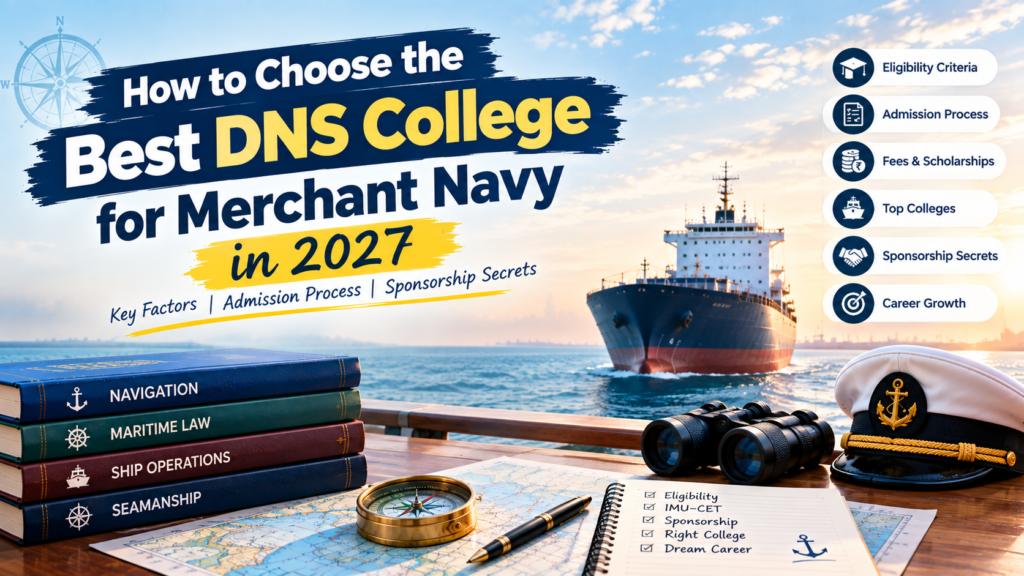
Quick Answer: Diploma in Nautical Science (DNS) is a 1-year pre-sea course approved by the Directorate General of Shipping (DGS) designed to fast-track Class 12 PCM students into a deck cadet career. Success requires clearing the IMU-CET exam, passing strict medical standards, and securing a company sponsorship. To maximize your chances, leverage free tools and expert prep ecosystems like Sailors Factory.
What Is DNS (Diploma in Nautical Science)?
Diploma in Nautical Science is an annual pre-sea course authorized by the Directorate General of Shipping (DGS) that helps Class 12 students enter the world of shipping careers by qualifying as Deck Cadets. In addition to various maritime subjects like navigation, ship security, seamanship, communications, and the English language, physical fitness and academic courses for clearing IMU-CET are part of the DNS curriculum.
After the successful completion of DNS, cadets undergo around 18 months of sea experience along with training for obtaining a Second Mate Certificate of Competency (CoC). With the completion of the Second Mate CoC, the candidate earns a Bachelor of Science degree in Nautical Science, contrary to the popular belief that the DNS is a “dead-end diploma”. The fact is that both the courses – two-year DNS and three-year BSc Nautical Science – result in the same degree and career progression.
Admission to DNS programs in India is based on performance in IMU-CET (Indian Maritime University Common Entrance Test); hence, the quality of your preparation for the entrance exam is as important as the college you finally get admitted to. A smart scorer in IMU-CET has more options regarding good institutes, good batches, and top-tier sponsors. Ace your prep using the IMU-CET Test Series & Mock Test.
DNS vs BSc Nautical Science: Which Should You Choose in 2027?
Many aspirants get confused between DNS and BSc Nautical Science while shortlisting colleges. Here’s a quick comparison to help you decide:
| Factor | DNS | BSc Nautical Science |
| Duration | 1 year pre-sea + sea time | 3 years residential |
| Entry Point | Faster entry into sea training | Longer academic phase before sailing |
| Final Qualification | BSc degree after CoC (Second Mate) | BSc degree after 3 years + sea time |
| Cost | Generally lower upfront | Generally higher, spread over 3 years |
| Best Suited For | Aspirants who want to start sailing sooner | Aspirants who prefer a longer campus academic phase |
None of these choices is necessarily the “better” choice because that really depends on the individual’s financial situation and the speed at which he or she wants to be earning money while working aboard ships. To evaluate your financial readiness, check out the Merchant Navy Salary Calculator. It is much more important where the training will take place than whether it will be DNS or BSc.
Why Choosing the Right DNS College Matters
All DNS colleges do not provide equal results. The correct institute is not only one that will give you education in subjects such as Physics, Maths, and General Knowledge for IMU-CET. It will prepare you for the Pre-Sea Medical test, PST (Personality and Psychometric Test), and, most importantly, get you a sponsorship from an esteemed shipping company after your course. No cap, this choice dictates your entire future!
Wrong decisions will result in the waste of time, money, and your Merchant Navy career before it begins. Year after year, thousands of cadets who have completed their course from DNS institutes find themselves unable to get any sponsorship due to improper preparation for interviews at their institute. To practice handling psychometric evaluations safely, check out the Free Psychometric Test.
Key Factors to Consider When Choosing a DNS College for 2027
1. DG Shipping Approval and Accreditation
Make sure you check whether the course offered by the DNS and the institute conducting maritime training is authorized by the Directorate General of Shipping. Any unauthorized course is a dead-end to your career as a Merchant Navy sailor.
2. IMU-CET Coaching & Preparation Quality
Since DNS admissions are conducted through IMU-CET, it is expected that the college or preparation ecosystem where you are enrolled has an updated curriculum, experienced mentors, and solid testing records. Do not fall for empty promises of “100% success”; ask for real data.
3. Faculty Experience
Find mentors who have knowledge about academia and the true shipping world, which means finding professors with sailing experience or industry links that can help mentor you during interviews and documentation.
4. Sponsorship and Placement Track Record
This is the single biggest deciding factor. An enrollment certificate by a DNS without the backing of a trustworthy shipping company is incomplete, as without this, structured onboard sea training will be difficult to secure. Choose a DNS that has a stellar history of assigning cadets to prestigious shipping companies. You can explore company pathways via Company Sponsorship Guides.
5. Interview and Personality Development Training
Shipping companies do not look at just marks; they evaluate the candidate’s confidence, communication, discipline, and attitude during Group Discussion and Personal Interview rounds. A good DNS college will prepare students for these rounds and not just for the IMU-CET written test.
6. Infrastructure and Discipline
The accommodation, the schedule, physical training, and a distraction-free environment are all necessary for an aspirant to live in the hostel. This is because life on a merchant ship requires structure and discipline right from the start.
7. Location and Accessibility
Consider how easy it is for you (and your parents) to visit, the cost of living in that city, and whether the surrounding environment supports focused study.
8. Transparent Fee Structure
Stay away from institutes that promise a lot but provide no cost breakdowns. Also, stay away from those that use exaggerated marketing tactics. Any institute worth its salt will always be honest in disclosing costs and maintaining a merit-based selection process.
Career Growth After DNS: What Comes Next
Understanding the full career ladder helps you evaluate whether a college is actually preparing you for long-term success, not just the diploma certificate:
- Pre-Sea Training (DNS): 1 year of academic and practical training
- Sea Time as Deck Cadet: around 18 months onboard a ship
- Second Mate CoC Exam: written and oral exams conducted by DG Shipping
- Officer Rank Progression: Third Officer — Second Officer — Chief Officer — Captain, with further CoC exams at each stage
Not only will a quality DNS college ensure that you are well-prepared for the entry test, but you will be ready for this entire experience. That is why sponsorship guidance and interview preparation must go hand-in-hand with classroom education.
Common Mistakes Aspirants Make While Choosing a DNS College
- Choosing based on advertising alone instead of verified results.
- Ignoring sponsorship history and focusing only on the “diploma certificate”.
- Not checking if faculty members have real maritime industry backgrounds.
- Underestimating the importance of interview and personality preparation.
- Delaying preparation and rushing IMU-CET registration at the last minute.
- Falling for institutes that falsely claim fake exclusive tie-ups with shipping companies.
Why Sailors Factory Is Your Ultimate Companion for DNS Preparation 2027
If you are serious about cracking IMU-CET and bagging authentic sponsorships from top-tier shipping companies, Sailors Factory is built precisely for you. Operating as a comprehensive companion platform from doubt to deck, it offers everything an aspirant needs without making you feel alone.
What makes Sailors Factory stand out?
- Daily Ritual Corner: Build consistency with daily practice quizzes via the Daily Voyage Quiz.
- Expert-Led Sponsorship Guidance: Specialized mentorship and training programs like Online IMU-CET Sponsorship Preparation.
- Rank Prediction Tools: Estimate your performance beforehand using the IMU-CET 2026 Rank Predictor.
- Medical Readiness Check: Test early for safety using the Colour Blindness Test.
- Professional Profile Building: Build industry-ready resumes with the Cadet Resume Builder.
- Solve My Problem Bro: Direct 1-on-1 support for any doubt you have along your preparation journey.
While selecting the right DNS college is an important step towards pursuing a career in the Merchant Navy, there is a lot of other information that aspirants need regarding eligibility criteria, sponsorship, medical fitness, admission processes, and career pathways.
The Sailors Factory ecosystem has been developed with the core mission of guiding aspirants through every twist and turn. Whether you are self-prepping or balancing outside coaching, we keep you aligned with real industry standards.
How to Apply: Step-by-Step
- Check your eligibility: Class 12 with Physics, Chemistry, and Mathematics and the minimum required aggregate using the Merchant Navy Eligibility Calculator.
- Register for IMU-CET: Through the official Indian Maritime University portal.
- Join a dedicated preparation track: Leverage top-tier resources like the Online IMU-CET Sponsorship Preparation well ahead of the exam.
- Prepare for Pre-Sea Medicals: Keep eyesight and health standards in check early.
- Practice PST/GD/PI rounds: Shipping companies weigh personality and communication heavily.
- Shortlist DGS-approved DNS institutes: Base your final choice on sponsorship records, faculty expertise, and infrastructure.
- Secure admission: Begin your one-year DNS training with total confidence.
Choosing the right DNS college in 2027 isn’t just about clearing an entrance exam — it’s about setting the foundation for a lifelong Merchant Navy career. Research thoroughly, verify sponsorship records, connect with peers in our official WhatsApp Community, or Contact Us directly if you need help! If our platform cleared your path today, do leave a review on our Google Review Page.
FAQ’s (Frequently Asked Questions)
Q1. What is the eligibility for DNS admission in 2027?
Eligibility requirements include candidates having completed Class 12th with Physics, Chemistry, and Mathematics, securing the minimum qualifying marks stipulated for IMU-CET, and fulfilling the age and health-related criteria laid down by DG Shipping.
Q2. Is DNS better than BSc Nautical Science?
Both qualify you for a Deck Officer career and a subsequent BSc degree upon sea experience. While DNS is a one-year course providing fast-track access to sea training, BSc Nautical Science is a three-year residential course. Your choice should depend on your budget, timeline, and personal preference.
Q3. How important is sponsorship after DNS?
Very crucial indeed. The lack of sponsorship by a shipping company will make it difficult for a cadet to complete the requisite number of months at sea required to acquire the Second Mate CoC, making the institute’s sponsorship network vital.
Q4. Does Sailors Factory guarantee a shipping company job?
Sailors Factory provides rigorous academic preparation, psychometric training, interview grooming, and mentorship to make you fully industry-ready. Selections ultimately depend on your performance and company merit standards.
Q5. When should I start preparing for IMU-CET 2027?
The earlier, the better. As the syllabus covers Physics, Maths, English, Reasoning, Aptitude, and General Knowledge thoroughly, starting early gives you an unbeatable advantage over candidates starting last-minute.
Q6. What subjects are tested in IMU-CET?
IMU-CET covers Physics, Mathematics, Chemistry, English, General Knowledge, and Reasoning/Aptitude. Selected candidates also undergo a Personality and Psychometric Test (PST) during company interviews.
Q7. Can DNS cadets pursue higher ranks like Captain later?
Yes. Following DNS and required sea service, cadets who pass the Second Mate CoC exams progress from Third Officer to Second Officer, Chief Officer, and ultimately Captain, exactly like BSc Nautical Science graduates.
Q8. How do I contact Sailors Factory for admissions and mentorship?
You can visit the Sailors Factory Homepage, fill out our Registration Google Form, or reach out via Contact Us to know more about ongoing batches and preparation tracks!