Quick Answer: What is ADNS in Merchant Navy and how does it differ from DNS? ADNS (Advanced Diploma in Nautical Science) is an advanced maritime education pathway for deck-officer aspirants. Unlike the standard 1-year pre-sea DNS (Diploma in Nautical Science) route, ADNS structures can vary significantly—appearing either as an advanced qualification after sea training or as a specialized India-UK integrated program. To navigate this pathway safely without falling for shady agents, you must verify DGS approvals and lean on trusted peer communities like the Sailors Factory WhatsApp Community for real officer mentorship.
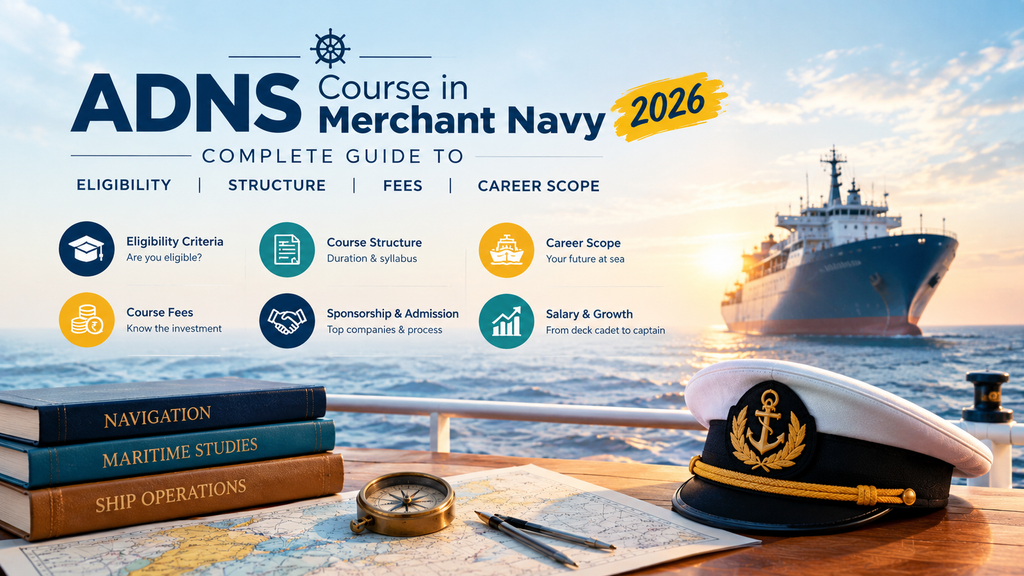
Yo future deck officers! If you’re exploring career options after 12th grade and have heard whispers about the Advanced Diploma in Nautical Science (ADNS) alongside DNS, you’re probably wondering what the actual deal is in ADNS course in merchant navy.
Let’s keep it 100% real—navigating maritime course names can get confusing very quickly. Whether you’re prepping solo from a Tier-3 town, juggling local coaching somewhere else, or just starting from absolute scratch, you don’t have to figure it out alone. Jump into the official Sailors Factory WhatsApp Community and let’s guide you from doubt to deck!
Before spending a single rupee on application forms or confusing courses, run a quick reality check using the free Sailors Factory Eligibility Calculator to see where you stand.
This 2026 updated guide covers everything you need to know about ADNS:
- What Is ADNS in the Merchant Navy?
- ADNS vs DNS: What Is the Difference?
- ADNS Course Duration & Structure
- ADNS Eligibility Criteria 2026
- ADNS Course After 12th
- ADNS and Merchant Navy Career & Sea Training
- ADNS Course and Certificate of Competency (CoC)
- ADNS India-UK Maritime Programmes
- Is ADNS Approved by DG Shipping?
- ADNS Course Fees & Sponsorship
- Medical & Eyesight Requirements
- Things to Check Before Taking ADNS Admission
- Frequently Asked Questions (FAQs)
ADNS stands for Advanced Diploma in Nautical Science.
It is designed around the professional development of students preparing for a high-flying career on the deck side of merchant ships. Training focuses on advanced nautical knowledge, navigation, seamanship, ship operations, safety, and the skills required to crush officer-level responsibilities.
The exact structure can differ wildly between institutions. Some programmes use ADNS as a qualification associated with the post-DNS/sea-training stage, while newer programmes may offer ADNS as a complete international pathway involving study in India followed by study in the United Kingdom.
This distinction matters when comparing ADNS courses. A student should never assume that every course advertised as “ADNS” has the same duration, qualification, admission process, or certification pathway.
ADNS vs DNS: What Is the Difference?
DNS and ADNS are both connected to the deck-officer career, but they are not interchangeable.
| Feature | DNS (Diploma in Nautical Science) | ADNS (Advanced Diploma in Nautical Science) |
|---|---|---|
| Full Form | Diploma in Nautical Science | Advanced Diploma in Nautical Science |
| Core Structure | Usually a 1-year pre-sea programme | Structure depends entirely on the institution |
| Entry Point | Designed as an entry route after Class 12 PCM | Can be post-DNS or an alternative structured program |
| Onboard Phase | Followed by 18 months of sea training | May include advanced academic/nautical training and/or sea components |
| Career Stage | Leads straight into the deck-cadet pathway | Builds towards higher-level nautical qualifications |
| Approvals | Offered by DGS/IMU-approved institutions | Recognition and structure must be verified per program |
The standard Indian DNS route is described by IMU as a one-year residential program, after which students proceed towards required sea training and competency exams. Meanwhile, historical and specialized programs use ADNS to describe advanced qualifications or international credit-transfer structures.
ADNS Course Duration & Structure
There is no single duration that applies to every ADNS program because the name is used for completely different frameworks.
- India-UK Pathways: Some international ADNS programs advertised in India follow a 2-year study model, where Year 1 happens in India and Year 2 takes place at a UK maritime institution (such as City of Glasgow College).
- Post-Training Qualification: Other programs use ADNS as an advanced qualification after completing DNS and onboard sea time.
Before applying anywhere, always check:
- Total course duration
- Where each academic year is conducted
- Qualification awarded upon completion
- DGS approval or UK MCA recognition (if applicable)
- Sea-time requirements and sponsorship backing
ADNS Eligibility Criteria 2026
Eligibility depends entirely on the specific ADNS program structure:
- Direct After 12th Programs: If an ADNS course accepts students straight out of school, it typically mimics standard maritime criteria: Class 12 with Physics, Chemistry, and Mathematics (PCM), minimum percentage thresholds, English marks, age limits (usually 17–25 years), and strict medical/eyesight standards.
- Advanced Stage Programs: If ADNS represents an advanced stage after DNS, entry requirements look completely different because candidates are expected to already hold prior maritime training certificates.
Pro Tip: Never use the eligibility criteria of one institute for another. For standard comparison, the classic IMU DNS route requires 10+2 with PCM (minimum 60% aggregate) and 50% marks in English. Check your standing instantly with the Merchant Navy Eligibility Calculator.
Worried about whether your eyes make the cut? Don’t wait for a medical rejection—take an early self-check using the Colour Blindness Test for Merchant Navy.
ADNS Course After 12th: What You Need to Know
Students searching for ADNS right after 12th grade need to be extra cautious.
A conventional Indian deck officer pathway starts with a recognized pre-sea program like DNS, followed by 18 months of structured sea time. If an institute advertises ADNS as an integrated alternative straight out of school, you must evaluate its approvals, faculty credentials, and final certification value with a fine-tooth comb.
The ultimate goal of any nautical training is to prepare you for the deck department, where you will eventually climb these ranks:
Deck Cadet
    ↓
Third Officer
    ↓
Second Officer
    ↓
Chief Officer
    ↓
Master Mariner / Captain
Practical shipboard experience is non-negotiable. Whether through DNS or ADNS, your training will cover bridge watchkeeping, navigation, seamanship, cargo operations, safety procedures, and ship maintenance.
Calculate what your future paycheck looks like after graduation using the Merchant Navy Salary Calculator.
ADNS Course and Certificate of Competency (CoC)
A diploma certificate by itself should never be confused with a Certificate of Competency (CoC).
- The Diploma is your academic qualification from an institution or university.
- The CoC is the professional license issued by maritime authorities (like DG Shipping in India) that legally allows you to work as an officer onboard commercial vessels.
Always ask institute counselors: What specific CoC pathway does this ADNS program lead to, and which authority conducts the final competency exams?
ADNS India-UK Maritime Programmes
Some institutions promote international ADNS pathways where students spend Year 1 in India and Year 2 in the UK (e.g., partnering with UK nautical colleges under UK MCA frameworks).
While international exposure sounds incredible, remember that studying partly abroad doesn’t automatically satisfy all local flag-state or DGS compliance requirements unless explicitly approved. Always verify the paperwork before committing funds.
Is ADNS Approved by DG Shipping?
This is the million-dollar question. DGS strictly regulates maritime training in India and draws a sharp line between approved and unapproved courses.
- Never assume that an institute’s use of the term “ADNS” means the course holds official DGS pre-sea approval.
- Cross-check institute credentials directly on the official DG Shipping portal before paying booking tokens or tuition fees.
ADNS Course Fees & Sponsorship
Fees for ADNS programs vary wildly. An India-only advanced module has a different price tag compared to an India-UK international program that includes foreign tuition, GBP conversion rates, student visas, international travel, and overseas insurance.
Furthermore, sponsorship is king in the Merchant Navy. For standard routes, top shipping companies like Synergy Marine, Anglo-Eastern, Fleet Management, Great Eastern Shipping, MSC, and TORM sponsor cadets early. For ADNS programs, verify whether the company sponsorship guarantees actual shipboard training or just a hollow marketing promise.
Explore verified company hiring trends via the Merchant Navy Company Sponsorship guide.
Medical & Eyesight Requirements
Life at sea demands peak physical and mental fitness.
- Eyesight: 6/6 vision in both eyes is generally required for deck roles, with zero tolerance for color blindness.
- Medical Certification: Must be issued exclusively by a DG Shipping-approved medical practitioner.
Never rely on a quick check at a local optician. Get a proper maritime medical evaluation done early.
Things to Check Before Taking ADNS Admission
Before you sign any admission contract or hand over your hard-earned money, run this checklist:
- Is the institute and specific ADNS program officially approved by the relevant maritime authority (like DGS)?
- What exact academic qualification is awarded upon graduation?
- What is the total course duration and where is each semester conducted?
- How is sea training arranged, and is it guaranteed?
- What are the complete, transparent total course fees (including hidden expenses)?
- What is the exact CoC progression pathway after completion?
Sailors Factory Guidance for Aspirants
When exploring complex pathways like ADNS or prepping for standard IMU-CET and company sponsorships, preparation is your ultimate differentiator.
At Sailors Factory, India’s companion platform built by active Merchant Navy officers, we keep it 100% real: clearing maritime selection processes isn’t about guesswork—it’s about being battle-ready for aptitude tests, technical rounds, psychometric evaluations, and interviews.
How Sailors Factory Supports Your Journey
- Daily Practice Rituals: Build an unstoppable study habit with side-by-side challenges using the Daily Voyage Quiz.
- Comprehensive Test Series: Master exam speed with the Merchant Navy IMU-CET Test Series and Mock Test.
- Sponsorship & Psychometric Prep: Crack company recruitment rounds without getting blocked using the Merchant Navy Online IMU-CET Sponsorship Preparation and free Merchant Navy Psychometric Test Practice.
- Professional Resume Building: Craft standout application profiles in minutes using the Cadet Resume Builder.
- Solve My Problem Bro: Got doubts at 2 AM? Hop on a free 1-on-1 video call with a real officer via Sailors Factory Contact Us. No corporate chatbots, no hidden fees—just honest officer-to-aspirant mentorship.
Stay connected with thousands of fellow aspirants in the official Sailors Factory WhatsApp Community and let’s get you ready from doubt to deck!
Frequently Asked Questions (FAQs)
Is ADNS the same as DNS?
No. DNS means Diploma in Nautical Science (typically a 1-year pre-sea course), whereas ADNS means Advanced Diploma in Nautical Science, which can represent an advanced stage or specialized international pathway.
Can I join ADNS directly after Class 12?
Some institutes offer ADNS programs directly after 12th PCM, while others require prior maritime training. Always check the specific institute’s eligibility prerequisites.
Is ADNS a degree course?
Not necessarily. ADNS is a diploma qualification. Some hybrid programs may bundle additional degrees or overseas academic credits, so always verify the exact award text.
Does ADNS make me a captain?
No course instantly makes you a captain. You must progress sequentially through deck cadet, third officer, second officer, and chief officer ranks by logging required sea time and passing DG Shipping competency exams.
Is ADNS better than DNS?
There is no universal answer. The standard DNS route is heavily regulated by IMU and DGS with crystal-clear career progression, whereas ADNS structures vary widely. Always evaluate approvals and costs before deciding.
Is sponsorship necessary for ADNS?
Sponsorship terms vary by institute. Always confirm whether your tuition and onboard placement are officially backed by a ship-owning or ship-management company.
Can I work on foreign ships after ADNS?
Yes, provided your qualification meets international STCW standards and the flag-state employer’s specific certification and medical requirements.
No course title guarantees employment by default. Job placement depends on your sponsorship terms, academic performance, medical fitness, and successful completion of sea training.