If you want to become a member of the merchant navy after Class 12, the DNS (Diploma in Nautical Science) is one of the most preferred courses opted for by people who want to become deck officers.
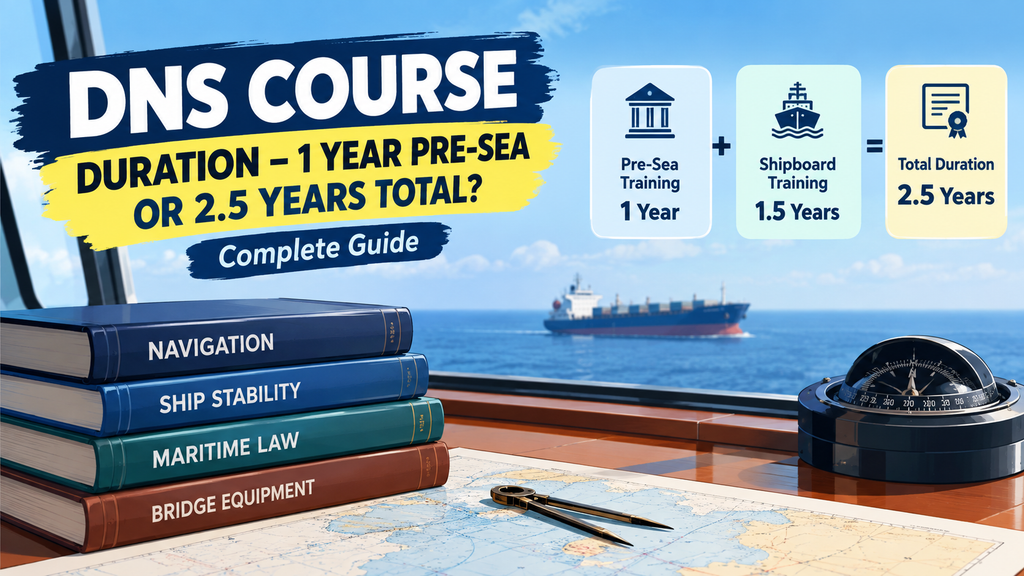
Quick Answer: The DNS pre-sea college program is 1 year, but when combined with the mandatory 1.5 years of shipboard training required by DGS, the total training duration to become fully eligible is approximately 2.5 years.
“What is the duration of the DNS course?” is perhaps one of the most frequently asked questions by the students. However, it is not as simple as answering “one year.” The period of the pre-sea DNS course is typically one year, but then comes the shipboard training/exams that make you eligible for the journey of getting certified as an officer.
According to the present data available on the Indian Maritime University website (IMU), DNS is a 1-year residential course. According to the DGS Training Manual, DNS is 1 year of pre-sea training plus 1.5 years of shipboard training, which makes the overall training period nearly 2.5 years.
If you are trying to navigate this complex selection process alone, remember that you don’t have to walk this path by yourself. Through active platforms like the Sailors Factory WhatsApp Community, aspirants connect daily for peer accountability, doubts, and guidance. Whether you are preparing completely on your own, taking coaching elsewhere, or just starting from scratch, having a preparation partner changes everything.
What Is the DNS Course?
DNS is an abbreviation for the Diploma in Nautical Science. This is a pre-sea training scheme that aims at grooming the cadets who are planning to join the deck side of the Merchant Navy.
Some of the areas covered under the above-mentioned diploma course include the following:
- navigation & chart work
- ship construction & stability
- seamanship
- cargo handling & stowage
- bridge equipment
- watchkeeping
- meteorology
- maritime communication
- maritime legislation
- emergency procedures
The main purpose of this course is to prepare the cadets for their future on-board training.
DNS Course Duration: Is DNS 1 year or 2.5 years?
This is where many students become confused.
1. Pre-Sea DNS Course – 1 Year
The real DNS college/pre-sea program is typically 1 year long. As mentioned in IMU, “IMU’s DNS program is a 1-year residential program consisting of two semesters that comprises theoretical and practical/lab components.”
Therefore, whenever someone says that
“DNS is a 1-year program.” They are talking about the pre-sea program.
2. Shipboard Training – 1.5 Years
After the completion of pre-sea training, the training route encompasses shipboard training.
The current DGS training manual shows the following:
- Pre-sea training for DNS: 1 year
- Shipboard training: 1.5 years
- Total training period: 2.5 years
Thus, students cannot expect that completion of the one-year college course automatically qualifies them as a deck officer. Sea training is an integral part of the career development process.
DNS Course Duration at a Glance
| Stage | Approximate Duration |
|---|---|
| DNS Pre-Sea Training | 1 Year |
| Shipboard Training | 1.5 Years |
| Total Training Pathway | About 2.5 Years |
| Further Certification/Examinations | As prescribed by the applicable rules |
The exact progression can depend on applicable DGS requirements, examinations, documentation, and the training route followed by the cadet.
What Do You Study During the 1-Year DNS Course?
The DNS curriculum is not simply classroom-based PCM preparation.
IMU’s current DNS program includes subjects such as:
Semester 1
- Applied Mathematics
- Applied Sciences
- Ship Building and Ship Stability
- Navigation and Chart Work
- Bridge Equipment and Watchkeeping & Meteorology
- Cargo Handling and Stowage & Seamanship
- English and Human Factors
In addition, students undergo practical work in labs, workshops, and seamanship subjects.
Semester 2
The second semester continues with areas including:
- Navigation and Chart Work
- Modern Navigation Instruments
- Watchkeeping & Meteorology
- Cargo Operations and Seamanship
- Construction & Stability of Ships
- Knowledge of MARPOL and Marine Engineering
- Emergency Actions
- Communication at Sea
- Commercial Shipping
This means that the DNS course is considerably different from standard university courses since the trainees are taught professional shipping practices.
What Happens After Completing the 1-Year DNS Course?
The overall path may be viewed as follows:
Class 12 PCM > Admission/Sponsorship Process > DNS Pre-sea Training > Sea Training on Board > Necessary Exams/Certification > Deck Officer Profession
Hence, the DNS for one year constitutes the pre-sea part only, but not the whole process of becoming an eligible officer.
One needs to be aware of the present-day requirements of the DGS in relation to his/her batch.
DNS Eligibility: What Should Students Check?
Before worrying about the duration of a particular course, students need to determine whether they are eligible or not.
For instance, according to the present DNS details for IMU, the criteria are as follows:
- 10+2 in Physics, Chemistry and Mathematics
- Aggregate of 60% in PCM
- English – 50%
- Fitness requirements
- Age requirement for admission and other relevant conditions of DGS & IMU
It is to be noted that eligibility depends upon the admission notice, the institute, the company providing sponsorship, and the relevant rules of DGS & IMU. You can check eligibility here; click the Eligibility Calculator.
DNS Sponsorship: Why Is It Important?
In the case of many applicants to DNS, sponsorship is an integral part of the admission process.
A candidate would need to face the following:
- Entrance test
- Sponsorship test
- Interview
- Medical test
- Verification of documents
- College admission
- Pre-sea training
- Shipboard training
Each company and admission cycle differs in its process.
That is why DNS preparation cannot be confined only to mathematics and physics. Students need to be aware of the sponsorship process, fitness, documentation, and the whole Merchant Navy career path as well.
How Sailors Factory Helps With DNS Preparation
If you are preparing for IMU CET and Merchant Navy sponsorship exams, then Sailors Factory is your ultimate preparation companion. Whether you are studying entirely on your own or taking coaching elsewhere, Sailors Factory integrates seamlessly into your routine.
Students get access to structured resources, including the Daily Voyage Quiz, the Merchant Navy IMU-CET Test Series and Mock Test, and the Free Psychometric Test Module.
Students should know that coaching is only for entrance and sponsorship preparation, whereas the actual certification of DNS is done at an appropriate maritime training institute recognized under relevant regulations.
If you are looking for a proper program of preparation and mentorship, then you can explore the Sailors Factory Online IMU-CET & Sponsorship Preparation Program.
Another valuable source that candidates should use alongside Sailors Factory is the digital ecosystem provided for modern aspirants.
It will give you all the information on Merchant Navy applications, dates, eligibility, sponsorship, and preparation. As for a student who prepares for admission into the DNS school, tracking application deadlines is really critical, as you may fail your admission process if you miss any deadlines or applications.
Understand the Career Before Joining
Before making payments and enrolling in any DNS colleges, the student must be aware of how life and training in the Merchant Navy work.
Sailors Factory offers educational resources that include topics such as the following:
- Joining the Merchant Navy
- DNS
- IMU CET
- Sponsorship
- Deck Careers
- Engineering Careers
- Maritime Exams
- Life At Sea
- Professional Development
- And many others.
Why Course Duration Should Not Be Your Only Selection Factor
It is a frequent error to look up the following:
“Shortest Merchant Navy course.”
But students need to consider the following:
- Approval status of the institute
- Mode of admission
- Sponsorship facilities
- Medical conditions
- Quality of training
- Facilities for accommodation
- Records for placement or sponsorship
- Fee structure and refund policy
- Arrangements for ship training
- Student feedback
- Current regulations
A one-year course in DNS is just a starting point.
DNS vs. B.Sc. Nautical Science Duration
Students often compare DNS with B.Sc. Nautical Science.
Broadly:
| Course | Pre-Sea/Academic Duration |
|---|---|
| DNS | 1 Year |
| B.Sc. Nautical Science | 3 Years |
The DGS Training Manual, in its separate categories, mentions 1.5 years of onboard training for DNS and 1 year for B.Sc. Nautical Science in the prescribed training format.
Hence, the students must take into consideration the total training period, not only the years spent in college.
Final Takeaway
A simple solution to “How long is the DNS course?” is:
DNS College/Pre-sea Course = 1 year.
However, the entire training cycle of a DGS should not be confused with this one-year college program. As per the latest version of the DGS Training Manual, there will be 1.5 years of training onboard after the 1-year DNS pre-sea course, which sums up to about 2.5 years of training for the specified completion of the course.
For DNS admission, start preparations early on. Apart from PCM preparation, know about IMU CET, sponsorship exams, fitness, documents, and the entire deck officer career path.
For preparation for IMU CET and sponsorship, take a look at Sailors Factory Programs and connect via the Sailors Factory WhatsApp Community.
Never forget to verify the latest notification of IMU/DGS before admission to any institute/company.
FAQ’s (Frequently asked Questions)
1. Is DNS really a 1-year course?
Yes. The DNS pre-sea program takes around 1 year in general. But in addition to that, there are 1.5 years of onboard training by DGS, which makes the total training period around 2.5 years.
2. Is DNS better than B.Sc. Nautical Science?
None of these options can be said to be inherently superior to the other. The DNS option involves a shorter period of academics before going to sea, whereas the B.Sc. Nautical Science takes three years to complete.
3. Can I become a Third Officer immediately after completing DNS?
Not really. Simply finishing the one-year pre-sea program does not necessarily qualify an individual to become a third officer. One should also complete other requirements such as sea training, examinations, and competence certification.
4. Is sponsorship compulsory for DNS?
The admissions and sponsorship procedures vary from one institute to another as well as from one company to another, depending on the mode of admission.
5. What is the total DNS training duration?
Under the DGS Training Manual, the pathway is listed as 1 year pre-sea training + 1.5 years shipboard training = 2.5 years.
6. What should I prepare for DNS admission?
Develop a good grounding in physics, mathematics, chemistry, English, and aptitude/reasoning subjects, along with knowledge of sponsorship, medical fitness, documentation, and the Merchant Navy career path. You can verify your physical metrics early using the Colour Blindness Test and estimate your future earnings with the Merchant Navy Salary Calculator.