If you have completed Class 12th and wish to follow your passion for being a seafarer after taking physics, chemistry, and mathematics as subjects, the DNS course for the merchant navy is one of the quickest ways to achieve the status of a deck officer. This manual is meant to be an all-inclusive guide to understanding the DNS course in the merchant navy, including its contents, procedure, and how you can prepare effectively using the Sailors Factory community ecosystem.
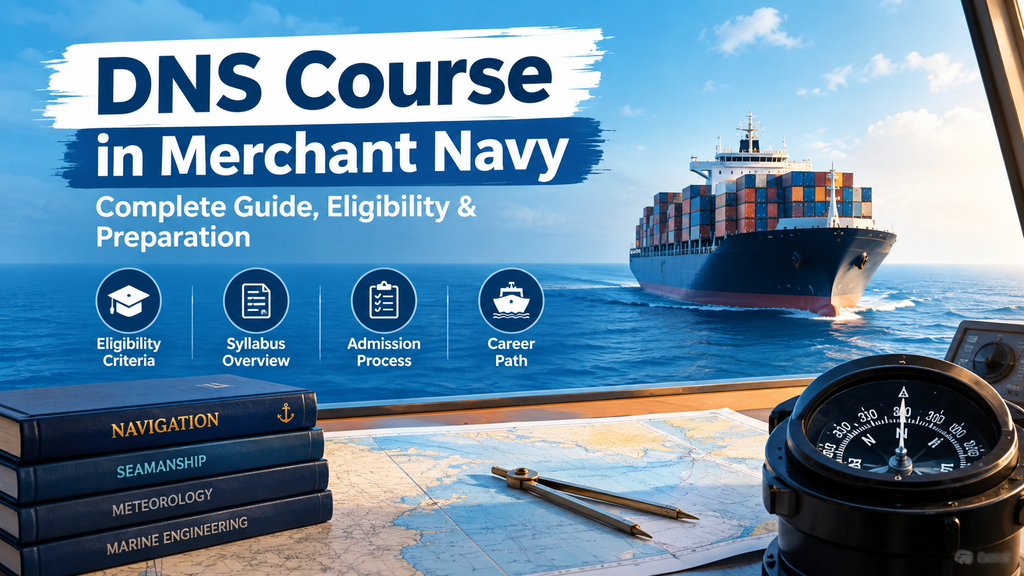
The DNS course in the merchant navy refers to the Diploma in Nautical Science, a 1-year residential pre-sea training program approved by DG Shipping. It serves as the fastest direct route for 12th PCM pass-outs to step onto a container or bulk carrier as a Deck Cadet, earn an onboard stipend of $400 USD/month, and eventually rise to the rank of Captain. Because this path is highly competitive, thousands of aspirants connect daily through the Sailors Factory WhatsApp Community for peer support, mentorship, and daily practice accountability.
DNS refers to the Diploma in Nautical Science, which is a one-year residential pre-sea training course that is DG Shipping-approved. The course is offered by various maritime institutes that have a connection with IMU. DNS is for those aspiring to join the deck department of the merchant navy and ultimately become captains (master mariners).
The curriculum of DNS involves theoretical studies in navigation, seamanship, meteorology, ship stability, and naval architecture, with pre-sea practical training. Upon its successful completion, cadets will undergo 18 months of sea training as deck cadets/trainee navigating officers (TNOs), where they will receive a stipend, boarding, and lodging free of cost.
DNS is held in two semesters on a residential campus wherein students stay on campus and live like cadets in a maritime academy, involving physical training, uniform discipline, and hostel life.
DNS Course Eligibility Criteria
Before making an application, make sure you satisfy all of the following criteria:
- Academic qualification: Pass 10+2 (or equivalent), securing not less than 60% aggregate marks in PCM (physics, chemistry, and mathematics).
- English qualification: Obtain not less than 50% marks in English, either in Class 10 or Class 12.
- Alternative routes: You could also fulfill the eligibility criteria if you pass a B.Sc. in any of the following: physics, mathematics, chemistry, and electronics (physics to be compulsorily studied) and secure 55% marks or a BE/B. Tech secured 50% marks.
- Age criteria: Generally 17 to 25 years as per the institute and the sponsoring organization.
- Marital status: Must be unmarried.
- Medical criteria: 6/6 vision in one eye and 6/9 in the other; no color blindness (by means of the Ishihara chart). You can verify your physical baseline early using the Colour Blindness Test for Merchant Navy.
Eligibility norms can be revised by DG Shipping and IMU from time to time, so it’s important to verify your standing instantly using the Join Merchant Navy Eligibility Calculator before applying.
DNS Course Syllabus Overview
While the exact curriculum varies slightly by institute, most DNS programs cover:
- Navigation and Chart Work – principles of ship navigation, usage of nautical charts and instruments
- Seamanship – ropes, mooring, anchoring, and other ship handling
- Ship Construction and Stability — elements of naval architecture and stability of ships
- Meteorology and Oceanography — knowledge about weather phenomena and oceanic features
- Cargo Work — cargo handling on ships
- Maritime Communication (basic GMDSS) — radio communication and distress signals; Marine English and Bridge Resource Management
- Safety Training (various STCW modules) — firefighting, first aid, personal survival and personal safety & social responsibility
This theoretical and practical set of modules prepares cadets to become deck cadets right after the pre-sea training period.
DNS Course Admission Process
Admission to a top DNS course is not just based on application but on strategic preparation. Below is the usual process of admission:
- Pass the IMU CET: The Indian Maritime University Common Entrance Test (IMU CET) is the essential test that one must clear in order to get admission to most pre-sea courses, including the DNS course. You can check your projected rank using the IMU-CET 2026 Rank Predictor.
- Obtain company sponsorship: Most reputable shipping companies conduct their own tests along with interviews and psychological assessments. Sponsorship before or at par with the IMU CET process increases chances of selection. You can explore company-specific criteria via the Merchant Navy Company Sponsorship Guide.
- Join an approved maritime training institute: After clearing the entrance test and/or getting sponsorship, one is ready to enroll in an approved maritime training institute by IMU.
Since competition in getting admission and sponsorships is high, successful candidates usually undergo rigorous exam-specific practice through the Merchant Navy IMU-CET Test Series and Mock Test.
DNS Course Fees
There is an enormous variation in the fees for the DNS course across various colleges; they may range from approximately ₹3 lakh to ₹10 lakh plus for the entire year-long program. The sponsored candidates get discounts on fees or even complete sponsorship by their respective shipping companies. This is another good reason why getting a sponsorship is so important. Make sure you ask for the updated fee structure directly from your college of choice.
DNS vs. B.Sc. Nautical Science: Which One Should You Choose?
Another question that often arises in the minds of the aspirants is that of the comparison between a DNS and a 3-year B.Sc. Nautical Science degree. Here’s a brief comparison:
- The DNS is a 1-year diploma, after which you can board the ship while completing your academic degree at a distance-learning level once you are on the ship.
- The BSc Nautical Science degree takes 3 years to complete, and this degree program is done before going to sea. It may be noted that both these routes end at the same point—that of Deck Officer.
Career Growth and Salary After DNS
After completing the DNS course and sea training, you are eligible to take the Second Mate’s test and become an officer. The next few steps that one may follow in the career of being a deck officer are as follows:
- Deck Cadet / Trainee Navigating Officer — training period, stipend, plus board and lodging free of cost
- Third Officer — First Officer position after qualifying in the Second Mate’s exam
- Second Officer
- Chief Officer
- Captain (Master Mariner) — highest position on the deck side
There is a steep increment in salaries upon getting promoted each time. Deckside officers generally get a big boost in salary from third officer to captain, and many officers in the merchant navy enjoy tax benefits on the income earned by being at sea, based on tax residency (depending on how many days have been spent at sea in a financial year). You can estimate your future earnings across ranks using the Merchant Navy Salary Calculator.
Beyond pay, a merchant navy career offers global travel, exposure to international teams, and a clear, merit-based promotion path—something few other careers offer straight out of Class 12.
Why the Right Guidance Matters for DNS Aspirants
The DNS admission procedure is highly competitive, and making mistakes in this process, such as improper preparation for IMU CET, hasty sponsorship interviews, or wrong selection of institutes, may result in losing an entire year for the aspirants. That’s precisely why thousands of students from all over India rely on Sailors Factory—India’s leading companion platform for the entire Merchant Navy journey.
Built by active Merchant Navy officers, Sailors Factory prepares you until you clear—whether you are studying entirely on your own, taking coaching elsewhere, or starting from scratch.
- Daily Practice Routine: Build unbreakable habits through the Merchant Navy Quiz / Daily Voyage Quiz.
- Comprehensive Training: Access specialized modules through the Merchant Navy Online IMU-CET & Sponsorship Preparation Program.
- Psychometric Mastery: Practice under pressure with the Free Psychometric Test Module for Merchant Navy.
- Professional CVs: Build standout applications using the Cadet Resume Builder.
- Direct Doubt Resolution: Get personalized guidance directly by choosing to Contact Sailors Factory or filling out the Sailors Factory Support Form.
If you’re serious about a career at sea, having mentors who’ve guided hundreds of successful cadets makes all the difference between a shot in the dark and a well-planned career launch.
Final Thoughts
The DNS course in the Merchant Navy is one of the most straightforward paths towards a successful career as a deck officer and ultimately a captain in the future. But success is highly dependent on the preparation that goes into taking IMU CET, sponsorship interview strategy, and the institution you join for the program.
With the help of Sailors Factory’s experienced officer mentors and digital preparation tools, you can have both the guidance and resources to make your dream of joining the merchant navy a reality.
Eligibility conditions, fees, and admission procedures for the DNS course and IMU CET are subject to change and need to be verified with the concerned authorities, namely DG Shipping, IMU, or the institutions you are considering.
FAQ’s (Frequently asked Questions)
DNS is the full form of Diploma in Nautical Science, which is a year-long pre-sea course for future deck officers.
2. What is the eligibility for the DNS course?
A candidate should have a 10+2 qualification with PCM and a minimum of 60% aggregate and 50% in English, besides meeting the medical standards prescribed by DG Shipping.
3. Is IMU CET compulsory for DNS admission?
Yes, IMU CET is the compulsory examination for admission into DG Shipping-approved DNS courses, although the other requirement involves sponsorship by a shipping company.
4. What is the age limit for the DNS course?
Most institutes accept applicants from the ages of 17 to 25 years, although there may be slight variation between institutes and sponsors.
5. How is DNS different from B.Sc. Nautical Science?
The DNS is a one-year diploma course that makes you sail faster, and the degree part comes later through distance education, but the B.Sc. Nautical Science is a three-year regular course.
6. What is the career path after DNS?
Deck Cadet → Third Officer → Second Officer → Chief Officer → Captain (Master Mariner), following required sea time and officer examinations.
7. How much does the DNS course cost?
The fees can range from about ₹3 lakh to more than ₹10 lakh, according to the institutes. Sponsored candidates can get concessions in their fees.
8. How can Sailors Factory help with DNS admission?
Sailors Factory provides daily practice quizzes, test series, psychometric prep, rank predictors, and 1-on-1 officer mentorship for IMU-CET and sponsorship success.
9. Is the Sailors Factory ecosystem free to use?
Yes, many core tools like calculators, quizzes, and community discussions are completely free to support aspirants from all backgrounds.
10. Can girls apply for the DNS course?
Yes, the DNS course is available for both males and females who satisfy the requirements in terms of academics, medical fitness, and age.