Evaluating Private vs Government DNS Colleges in India is an essential step in ensuring that students choose the right pathway toward a rewarding career in the Merchant Navy. When comparing Private vs Government DNS Colleges in India, aspirants step closer to joining the deck crew of merchant ships as certified Deck Cadets. However, knowing which college and institute type best aligns with your career goals is critical.
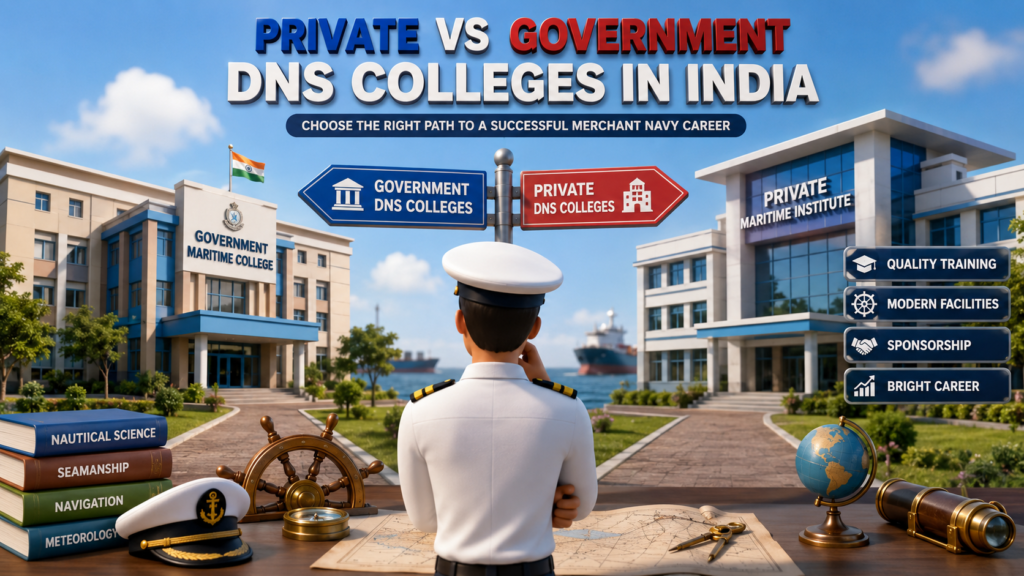
The most frequent question among aspiring maritime students and their parents is: Which option is superior—private maritime institutes or public institutions when evaluating Private vs Government DNS Colleges in India?
Each institute category offers unique benefits and structural differences. Aspirants must carefully weigh critical factors, including accreditation status, fee structures, campus infrastructure, practical training facilities, company sponsorships, faculty experience, hostel amenities, and overall institutional reputation.
Before finalizing any admission, candidates should cross-verify institutional compliance using the official Directorate General of Shipping (DGS) portal and check academic guidelines via the Indian Maritime University (IMU) official website. For further assistance, check out authoritative guidelines on the Ministry of Ports, Shipping and Waterways.
This guide provides a comprehensive breakdown of DNS colleges in India, helping you navigate the differences between private and government maritime institutions with support from Sailors Factory.
Diploma in Nautical Science (DNS) is a specialized maritime educational program tailored for candidates aiming to enter the deck department of commercial merchant vessels.
The program combines rigorous academic classroom instruction with mandatory sea service. Upon completing the required period of training and sea service alongside meeting all eligibility criteria, candidates become eligible to appear for competency examinations conducted by DGS-approved boards to qualify as licensed deck officers.
Students can verify their foundational eligibility parameters using the Sailors Factory Eligibility Calculator and cross-verify official standards for medical fitness requirements, eyesight standards, and admission protocols of individual maritime institutes.
Private vs Government DNS Colleges in India: Quick Comparison
When analyzing Private vs Government DNS Colleges in India, students find distinct structural variations across institutional models:
| Factor | Government DNS Colleges | Private DNS Colleges |
|---|---|---|
| Ownership | Government / Public Sector | Privately Managed |
| Fees | Generally structured and subsidized | Varies widely based on facilities |
| Infrastructure | Established over decades | Frequently modern and updated |
| Facilities | Standardized public systems | Ranges from basic to advanced simulation labs |
| Admission | Extremely competitive (via IMU-CET rank) | By institute and sponsor requirements |
| Sponsorship | Dependent on institutional ties and campus placement | Often bundled or aligned with specific shipping company sponsors |
| Training Environment | Rigid and traditional | Industry-aligned and adaptable |
| Location | Restricted options across specific zones | Widespread choices across various states |
| Student Support | Varies by institutional administration | Often features dedicated mentoring and career cells |
| Best For | Students prioritizing public-sector legacy | Students seeking diverse location choices and integrated sponsorships |
Important Note: There is no universal rule stating that every government college is automatically superior to every private college. The true quality of any maritime institute should be evaluated individually based on placement records, training simulators, and faculty expertise.
Government DNS Colleges in India
Government and public sector maritime colleges often command high prestige due to established institutional frameworks and historical roots in the national maritime sector.
Applicants eyeing government DNS programs should carefully verify the institution’s current DGS approval status, seat intake, and real placement metrics rather than relying solely on the “government” tag.
Advantages of Government DNS Colleges
Potential benefits often include:
- Formal, disciplined educational environment
- Established administrative systems and safety standards
- Highly competitive admission processes that attract top-tier peer groups
- Lower or subsidized tuition fee structures at select public institutions
- Highly experienced faculty members with extensive sailing backgrounds
- Strong reassurance for students and parents regarding institutional longevity
However, government ownership alone does not guarantee a direct path to employment or individual attention.
Private DNS Colleges in India
Maritime institutes managed by private organizations have grown significantly, forming a major pillar of India’s modern maritime education infrastructure. These colleges offer alternative, highly accessible avenues to complete the DNS program.
Because the quality among private institutes varies considerably, candidates are strongly advised to conduct thorough research before making fee commitments or accepting admission offers.
Advantages of Private DNS Colleges
Depending on the specific institution, students often benefit from:
- Modern classrooms equipped with advanced digital teaching tools
- Varied course availability and multiple campus locations across India
- Industry-oriented training modules synchronized with modern fleet requirements
- Dedicated student support systems and personalized mentoring
- Structured preparation assistance for company sponsorship interviews
- Comprehensive residential, sports, and modern hostel facilities
At the same time, aspirants must meticulously compare fees, DGS approval, training arrangements, verified placement records, sponsorship terms, refund clauses, and physical infrastructure prior to enrollment.
Private vs Government DNS Colleges: Which Is More Affordable?
Financial cost remains one of the primary decision-making factors for students and families evaluating Private vs Government DNS Colleges in India.
Government institutions generally maintain structured, predictable fee schedules, whereas private institutes feature varying price points reflecting their independent campus facilities and ancillary services.
However, students should never select a DNS college solely because it appears cheaper on paper.
Always evaluate the complete financial commitment, including:
- Tuition and semester fees
- Hostel and accommodation charges
- Mess and dining expenses
- Uniform and safety gear costs
- Textbooks, manuals, and study materials
- Mandatory medical and eyesight examinations
- Practical training and simulator fees
- University examination charges
- Travel costs to and from the campus
- Miscellaneous institutional development fees
Request a detailed, transparent fee breakdown directly from the institution before transferring any funds.
Sponsorship and Placement: What Should Students Check?
For most DNS aspirants, securing a shipping company sponsorship is the single most critical milestone.
Students must understand that studying at a prestigious college does not automatically guarantee a shipboard job or company sponsorship.
Before finalizing any admission, check:
- Which major shipping companies recruit or sponsor candidates from the institute?
- Is the sponsorship offer officially confirmed in writing?
- What does the company selection process entail?
- Are there separate company-administered entrance tests or panel interviews?
- What are the strict eligibility thresholds (such as PCM percentage and English scores)?
- Are there mandatory post-training service agreements or contractual bonds?
- What alternative options exist if company sponsorship is not achieved?
Avoid relying solely on verbal promises or flashy advertising campaigns. Always demand official documentation and verify claims independently using reliable guidance platforms like Sailors Factory Resources.
How to Choose the Best DNS College in India?
Rather than limiting your decision to a simple private versus government binary, ask these essential evaluative questions:
1. Is the Institute Properly Approved?
Verify the current Directorate General of Shipping (DGS) and Indian Maritime University (IMU) approval status for both the college and the specific DNS course.
2. What Is the Total Course Cost?
Do not evaluate institutes by tuition fees alone. Calculate the total investment over the duration of your training.
3. What Training Facilities Are Available?
Inspect the availability of dedicated seamanship laboratories, navigational simulators, engine workshops, and well-stocked maritime libraries.
4. What Is the Institute’s Track Record?
Examine genuine alumni career progression, board examination pass rates, and authentic feedback rather than marketing brochures.
5. What Sponsorship Opportunities Exist?
If company backing is a priority, understand the exact corporate tie-ups, selection criteria, and historical placement conversion rates.
6. How Effective Is Student Support?
Robust academic counseling, psychometric assessment guidance, and communication training add immense value during early professional formation.
Private vs Government DNS Colleges: Which One Should You Choose?
Selecting the right institution requires aligning your personal learning style, budget constraints, geographic preferences, and ultimate career aspirations.
Never base your choice solely on public versus private ownership. Instead, evaluate colleges across core pillars: statutory accreditation, simulator training quality, faculty pedigree, absolute cost, corporate sponsorships, institutional reputation, and cadet support systems.
For structured preparation, exam strategies, and guidance on clearing aptitude hurdles, platforms like Sailors Factory provide comprehensive learning resources tailored specifically to Merchant Navy aspirants.
Prepare for DNS Entrance and Sponsorship Exams
Securing a seat in a top-tier DNS program requires rigorous preparation for entrance examinations like the IMU-CET, psychometric evaluations, technical interviews, and corporate sponsorship screenings.
Utilizing dedicated preparation frameworks helps candidates strengthen core foundational subjects, including Physics, Mathematics, Chemistry, English grammar, logical reasoning, and general nautical awareness.
Explore the Sailors Factory IMU-CET Test Series for structured test series, mock interviews, and chapter-wise practice modules to step into selection exams fully prepared to secure high ranks.
Career Guidance and Preparation Ecosystems
Navigating maritime education can be complex. Leveraging specialized preparation platforms allows aspiring cadets to gain deep insights into entrance patterns, college rankings, sponsorship criteria, and fleet structures.
Accessing curated previous-year question papers, step-by-step mathematical solutions, company-specific interview question banks, and eligibility checkers ensures that students make data-driven career choices.
Student Success Stories and Results
The achievements of past trainees highlight the importance of disciplined study habits and effective mentorship in the maritime sector. Countless candidates have successfully gained admission to premier maritime academies and clinched competitive shipping sponsorships by adopting structured preparation methodologies. Tracking verified selection results helps aspirants gauge the efficacy of focused preparation resources.
Documents Students Should Check Before DNS Admission
As per standard regulatory admission guidelines, candidates must prepare and verify the following documents:
- Class 10 passing certificate and mark sheet
- Class 12 mark sheet and passing certificate
- Government-issued photo identification (Passport / Aadhaar)
- Recent passport-sized color photographs
- DGS-approved medical fitness certificate and eyesight report
- Scorecards of relevant entrance examinations (such as IMU-CET)
- Official company sponsorship letter (if applicable)
- Any additional affidavits or certificates requested by the institute
Common Mistakes to Avoid While Choosing a DNS College
Choosing a College Only Because It Is Government
While public status carries historical value, candidates must evaluate active training standards, current faculty, and real-world placement outcomes.
Choosing a Private College Without Verification
Never transfer booking or tuition fees based solely on unverified advertisements promising guaranteed high-paying fleet positions.
Ignoring Sponsorship Conditions
Understand whether a sponsorship offer is unconditional, conditional upon semester performance, or subject to secondary corporate evaluations.
Comparing Only Tuition Fees
Failing to account for hostel, food, uniform, and exam fees can lead to unexpected financial strain mid-course.
Not Checking Current Approval Status
Maritime regulations update frequently. Always confirm that the institute appears on active DGS compliance lists prior to enrollment.
Final Verdict: Private vs Government DNS Colleges in India
Your ultimate choice between private and government DNS colleges depends entirely on your financial comfort, career targets, location preferences, and sponsorship status.
Prioritize verified institutional accreditation, practical training quality, campus facilities, transparent pricing, and corporate backing over simplistic ownership labels.
Begin your preparation early, master your foundational concepts, and utilize rigorous mock testing to excel. Prepare smart, verify every admission claim independently, and choose your maritime pathway with absolute clarity.
Conclusion
The debate surrounding Private vs Government DNS Colleges in India remains a vital consideration for every Merchant Navy aspirant. There is no universal winner; success depends heavily on the individual institution’s integrity and training standards.
Research thoroughly, insist on authentic documentation, calculate total financial commitments, understand sponsorship terms thoroughly, and equip yourself with robust preparation strategies for entrance examinations.
FAQ’s (Frequently asked Questions)
1. Is a government DNS college better than a private DNS college?
Not necessarily. Students should compare approval status, training quality, fees, facilities, sponsorship opportunities, and reputation before choosing.
2. Are private DNS colleges good in India?
Many private DNS colleges deliver exceptional training and placement support. However, students must independently verify each institution’s compliance, infrastructure, and historical placement records.
3. Which is cheaper, private or government DNS?
Fee structures vary widely across institutions. Candidates should evaluate the total cost of attendance rather than assuming all government colleges are universally cheaper.
No college can legally guarantee employment. Shipboard placement and sponsorships depend on individual academic performance, medical clearance, and company interview selection.
5. What should I check before joining a DNS college?
Verify current DGS approval, fee transparency, simulator infrastructure, faculty credentials, sponsorship terms, and refund policies.
6. Is sponsorship important for DNS?
Yes. Securing a company sponsorship before starting your DNS course ensures your shipboard training placement is locked in early.
7. How can I prepare for DNS entrance and sponsorship exams?
Focus heavily on Physics, Chemistry, Mathematics (PCM), English proficiency, reasoning, mock tests, and structured interview preparation.
Dedicated preparation ecosystems like Sailors Factory offer mock test series, study cheatsheets, rank predictors, and company-specific interview guides to streamline your journey.
9. Where can I check my eligibility for specific shipping companies?
Aspirants can utilize online tools such as the Sailors Factory Eligibility Calculator to cross-verify their PCM percentages, age, and eyesight against the specific criteria of major shipping sponsors.